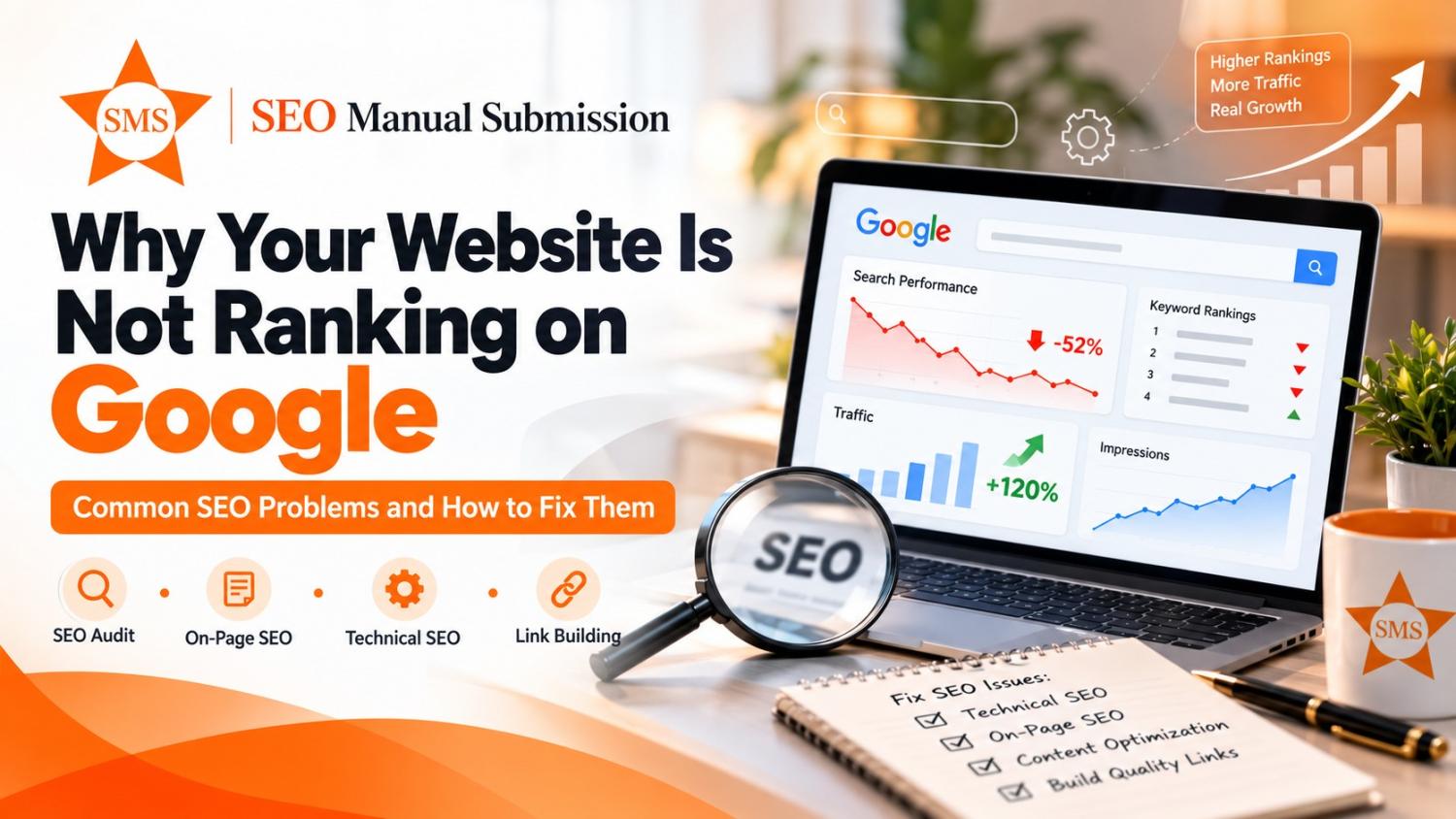
Why Your Website Is Not Ranking on Google: Common SEO Problems and How to Fix Them
A website can have excellent products, professional design, and hundreds of published pages yet struggle to attract visitors from Google. Discover the technical, content, authority, and search-intent issues that commonly prevent websites from performing well in organic search, and learn how to identify what deserves attention first.
A website does not need to disappear from Google completely to have an SEO problem. Sometimes, the pages are indexed but rarely appear for relevant searches. In other cases, rankings remain reasonably stable while organic traffic gradually declines. Businesses may also discover that their competitors consistently appear above them, even though their own websites have more pages, better designs, or a longer online history.
These situations can be frustrating, particularly when considerable time and money have already been invested in search engine optimization.
The difficulty is that poor Google rankings rarely have one universal explanation. A website might struggle because search engines cannot access important pages, its content does not satisfy search intent, its technical structure creates unnecessary obstacles, or its competitors provide more useful information.
A weak internal linking structure, inconsistent business information, and low-quality backlinks can add further complications.
Effective SEO troubleshooting starts by identifying the actual problem rather than applying the same solution to every website.
This guide explains the most common reasons websites fail to achieve satisfactory organic visibility, how to investigate them, and which improvements deserve priority when building a sustainable SEO strategy.
1. Understand the Difference Between Indexing, Ranking, and Organic Traffic
Before making changes to your website, it is important to understand three different aspects of Google Search performance.
Indexing means Google has added a page to its search index, making it eligible to appear in relevant search results. Indexing does not guarantee visibility for a particular keyword.
Ranking refers to a page's position when Google returns results for a search query. Positions can vary according to the query, location, device, and other search conditions.
Organic traffic represents visitors arriving through unpaid search results. Traffic depends not only on rankings but also on how frequently people search for relevant topics, the appearance of search results, and whether users choose to click.
A website can be successfully indexed and still receive almost no organic traffic.
For example, consider a digital marketing agency whose website appears on Google when someone searches its exact business name. However, when potential customers search for "SEO services for small businesses," the agency is nowhere near the first few pages.
This is not necessarily an indexing problem. The website is discoverable, but Google may consider other pages more relevant or useful for that particular search.
Similarly, a website might rank for hundreds of keywords that generate little meaningful business activity.
The first objective of an SEO investigation is to identify whether the primary concern involves discoverability, rankings, traffic, or conversions.
Google Search Console is particularly useful here. Its Performance report helps identify the queries and pages receiving impressions and clicks, while URL Inspection provides information about Google's indexing status for individual URLs.
Understanding these differences prevents wasted effort and helps establish a more accurate SEO improvement plan.
2. Important Website Pages Are Not Indexed by Google
One of the first things to investigate when a website is not showing up on Google is whether its important pages are indexed.
Search engines must discover, crawl, and process web pages before those pages can become eligible to appear in search results.
Several technical and structural problems can interfere with this process.
A page may accidentally contain a noindex directive. Important sections could be blocked through robots.txt restrictions. Canonical signals might indicate that another URL should be treated as the preferred version. Sometimes, Google simply has not discovered a newly published page or has chosen not to index it.
Large websites may also contain thousands of low-value URLs that complicate crawling and create unnecessary duplication.
How to identify indexing problems
Start by opening Google Search Console and reviewing the indexing information for your website.
Pay particular attention to important commercial pages, core service pages, product categories, and recently published articles.
Use the URL Inspection tool to investigate individual pages rather than relying exclusively on a site: search in Google, which does not provide a complete indexing report.
If an important page is not indexed, investigate why.
Check whether:
-
The page returns a successful HTTP response and is accessible to visitors.
-
A
noindexdirective or robots.txt restriction prevents appropriate search access. -
The page has internal links through which search engines can discover it.
-
Canonical signals are consistent with the preferred version.
-
The content provides sufficient unique value to justify inclusion in search results.
An XML sitemap can help search engines discover preferred URLs, but submitting a sitemap does not guarantee indexing.
The most effective approach is to correct the underlying issue, verify the affected URL, and allow Google to reassess the page.
3. Your Content Does Not Match What People Actually Want to Find
Search intent is one of the most important considerations in modern SEO.
A page can use the right keywords and still fail to satisfy the people searching for them.
Imagine someone entering "how to perform an SEO audit" into Google. That person probably wants instructions, examples, or a practical checklist.
Now consider someone searching for "professional SEO audit services." This user may be comparing agencies, reviewing service deliverables, or preparing to request a quotation.
The topics are related, but the expected results are different.
A single page that attempts to satisfy both audiences without a clear purpose may struggle to perform well for either query.
Understanding different search intentions
| Search query | Likely user expectation |
|---|---|
| What is technical SEO? | An informative explanation |
| How to fix website indexing issues | A troubleshooting guide |
| Best SEO audit tools | A comparison or recommendations |
| SEO audit services | A professional service provider |
| SEO agency near me | Relevant local businesses |
Search engines aim to present results that best address the underlying purpose of a query.
That means content planning should begin with understanding the audience rather than simply inserting frequently searched phrases into headings.
If your website offers SEO services, an educational guide should genuinely help readers understand a problem. A service page, meanwhile, should explain what the service includes, who needs it, and how potential customers can proceed.
Both types of content are valuable, but they serve different stages of the customer journey.
Practical recommendation: Before developing or updating a page, examine the type of information users expect from its primary search query. Build the content around that need, then introduce relevant services naturally where they can help the reader.
4. Several Pages Are Competing for the Same Keywords
Publishing more pages is not always the best way to improve Google rankings.
A common issue occurs when a website creates multiple articles or service pages targeting nearly identical topics without clearly differentiating their purposes.
This is often described as keyword cannibalization.
For example, an SEO website might publish separate articles titled "How to Improve Google Rankings," "Ways to Rank Higher on Google," and "Tips for Better Search Engine Positions."
These articles are not automatically problematic. They become an issue when they substantially repeat the same information, address the same intent, and provide little reason for readers to choose one over another.
Search engines may then encounter several similar pages without a clear primary resource.
The website can also divide its internal links and promotional efforts among overlapping URLs.
When should you consolidate content?
Start by reviewing the organic queries associated with each page in Google Search Console.
If multiple URLs receive impressions for similar keywords, evaluate their content, purpose, and performance.
Sometimes, keeping separate pages is appropriate because each serves a distinct audience or search intention.
In other situations, combining overlapping material into a stronger, more comprehensive resource creates a better experience.
When consolidating pages, preserve useful information, update relevant internal links, and use appropriate redirects if URLs are retired.
Avoid deleting content merely because two pages rank for some of the same keywords. Overlap alone does not prove a problem.
The goal is to establish a clear editorial structure in which every important page has a meaningful purpose.
5. Thin, Repetitive, or Unhelpful Content Limits SEO Performance
Content quality cannot be measured accurately by word count alone.
A short page that provides exactly what visitors need may perform better than an extremely long article filled with repetition.
Likewise, publishing hundreds of articles does not necessarily establish a website as a reliable resource.
The more important question is whether the content provides information that is useful, accurate, relevant, and sufficiently complete for its intended audience.
Consider an article titled "Complete Guide to Local SEO."
If the article only explains that local SEO helps businesses appear on Google and then repeats basic definitions, visitors seeking practical advice will probably leave without resolving their questions.
A genuinely useful guide would discuss Google Business Profile optimization, business information consistency, local landing pages, customer reviews, relevant citations, and methods for assessing local visibility.
It might include examples of problems businesses encounter and explain how to solve them.
This distinction matters because strong SEO content should accomplish something beyond occupying space on a webpage.
What makes content genuinely valuable?
Useful content typically demonstrates a clear understanding of the subject. It explains important concepts without unnecessary complexity and helps readers make informed decisions.
Original examples, realistic scenarios, screenshots, practical observations, and well-supported explanations can make a substantial difference.
Businesses should also ensure that content reflects their actual expertise.
A company offering technical SEO services, for example, can strengthen educational material by explaining the types of crawl issues it encounters, how it investigates conflicting canonical signals, or why certain website migrations require special attention.
Specific, experience-informed explanations are more useful than generic marketing claims.
For websites that already contain extensive blog archives, updating valuable older content may sometimes be more productive than publishing another article covering the same information.
A professional content marketing strategy should therefore balance new publishing with improving the accuracy, organization, and usefulness of existing resources.
6. Weak On-Page SEO Makes It Difficult to Understand Your Pages
On-page SEO involves optimizing the visible content and important page-level elements that help visitors and search engines understand a website.
Even a well-written article can underperform when its title is unclear, its headings are poorly structured, or its content never establishes the central topic.
For instance, a website offering professional website auditing might use a page title such as "Our Premium Solutions."
Although this title may sound professional, it does not explain what the page actually offers.
A more descriptive title like "Professional Website SEO Audit Services" communicates the subject more clearly.
The same principle applies to headings, introductory paragraphs, URLs, image descriptions, and internal links.
However, optimizing a page does not mean repeating the primary keyword in every paragraph.
Excessive keyword repetition makes content uncomfortable to read and rarely adds useful information.
Effective on-page optimization combines clear subject identification with natural language and a logical information hierarchy.
Areas worth reviewing
An on-page SEO review should assess whether the title accurately represents the page, the H1 clearly introduces the subject, and supporting headings organize the material logically.
Meta descriptions should summarize the page and encourage appropriate clicks, although they are not a direct Google ranking factor.
Relevant images should include meaningful alternative text where needed for accessibility and understanding.
Internal links should guide readers toward useful supporting resources using descriptive anchor text.
Most importantly, the page should answer the primary question or meet the commercial need that brought the visitor there.
Businesses with large websites may benefit from a systematic on-page optimization review to identify inconsistencies across important URLs.
7. Your Website Has Technical SEO Problems
Technical SEO is the foundation that allows a website's content and structure to function effectively for both search engines and visitors.
A technically weak website may suffer from slow loading, broken links, inaccessible pages, confusing navigation, mobile usability problems, or inconsistent URL configurations.
These issues can affect the experience of visitors and, depending on the problem, interfere with crawling, indexing, or ranking.
Technical problems become particularly important when a website grows beyond a few pages.
E-commerce websites, publishing platforms, large service directories, and multilingual websites often require additional attention to URL handling, navigation, duplicate content, and crawl management.
Website speed and user experience
Imagine a visitor searching for a service on a mobile phone.
They find a relevant result, click the page, and discover that the main content takes too long to display. When they try to interact with the page, elements move unexpectedly or buttons respond slowly.
Even if the page provides excellent information, the experience creates unnecessary friction.
Google's Core Web Vitals evaluate important aspects of the user experience, including loading performance, responsiveness, and visual stability.
The commonly used metrics are Largest Contentful Paint (LCP), Interaction to Next Paint (INP), and Cumulative Layout Shift (CLS).
These measurements are useful diagnostic indicators, but improving a performance score alone does not guarantee better rankings.
Website owners should assess both measured performance and the actual usability of important pages.
Mobile usability and navigation
A technically functional page is not necessarily easy to use.
Text may be difficult to read, navigation menus may cover content, or important buttons may be too close together.
Contact forms that work on desktop computers may be inconvenient on smaller screens.
Mobile visitors should be able to read, navigate, and complete important actions without unnecessary effort.
Canonical URLs and duplicate content
Many websites unintentionally generate multiple URLs displaying substantially similar information.
Examples include URLs with tracking parameters, filtered product listings, or alternative versions of the same page.
Canonical tags help indicate preferred versions, but search engines evaluate several signals when choosing the canonical URL.
Inconsistent canonical tags, redirects, internal links, and sitemaps can create confusion.
A complete website SEO audit can help identify these technical problems and establish a practical order for resolving them.
8. Poor Website Architecture and Internal Linking Reduce Content Discoverability
Internal linking is one of the most frequently overlooked opportunities in SEO.
Many businesses publish articles regularly but fail to connect them meaningfully with existing pages.
As a result, valuable content may become difficult for visitors and search engines to discover.
Consider a website that offers SEO auditing, technical optimization, content development, local SEO, and link building.
Its blog contains detailed articles about each subject, but none of those articles link to relevant service pages or related educational resources.
Visitors must navigate the website independently to find additional information.
A better approach uses a clear content structure.
A comprehensive guide about website rankings can link to a technical SEO resource when discussing crawl issues, a content marketing page when explaining content quality, and a local SEO page when addressing map visibility.
These links serve the reader while helping search engines understand the relationships between pages.
Building topic clusters around pillar content
A topic cluster generally consists of a broad resource supported by more focused articles.
For example, a website might maintain a comprehensive SEO troubleshooting guide as its main resource.
Supporting articles could explore specific subjects such as indexing errors, internal linking, title tag optimization, local citations, technical audits, and backlink evaluation.
Each supporting article would cover its subject in greater depth and link naturally to relevant resources.
The main pillar article would provide context and guide visitors toward the detailed material.
This structure helps organize information around meaningful topics instead of producing disconnected articles.
Internal links should never be added solely to achieve a predetermined number. Their purpose is to make the website easier to navigate and understand.
9. Your Website Has Not Established Sufficient Trust and Credibility
Visitors evaluating a business website often look for evidence that the company is legitimate, knowledgeable, and capable of delivering its services.
They want to know who operates the business, what experience it has, and whether its claims are credible.
Search engines also use numerous signals to assess the usefulness and reliability of content.
Google's E-E-A-T framework refers to Experience, Expertise, Authoritativeness, and Trustworthiness. It is used in Google's search quality evaluation guidance, but E-E-A-T should not be mistaken for a single measurable ranking factor or a score that website owners can directly optimize.
Nevertheless, the underlying principles are valuable for creating better websites.
A professional service provider should explain its offerings clearly, provide accurate business information, and avoid unsupported claims.
Relevant case studies, authentic customer testimonials, team or author information, transparent service descriptions, and verifiable business details can strengthen visitor confidence.
For specialist content, author qualifications and credible supporting information may be particularly important.
Trust also depends on consistency.
A website claiming decades of experience while offering no meaningful information about its organization can raise questions.
Likewise, publishing invented testimonials, misleading statistics, or exaggerated ranking guarantees can damage credibility.
A trustworthy website does not need to make the loudest promises. It needs to provide enough reliable information for visitors to make confident decisions.
10. Your Backlink Profile Is Weak, Irrelevant, or Poorly Developed
Backlinks are links from external websites pointing toward your content.
They can help search engines discover pages and contribute to the assessment of a website's relevance and authority.
However, backlinks differ considerably in value.
A relevant editorial mention from an established industry publication is not equivalent to hundreds of links appearing on unrelated, low-quality websites.
The context of the link, the credibility of the linking website, the nature of the placement, and whether the link was created editorially all matter.
Why backlink quantity can be misleading
Some businesses evaluate link building entirely through the number of links acquired.
They may purchase large packages promising thousands of backlinks or submit their website indiscriminately to directories with no relevance to their business.
This approach often focuses on superficial metrics rather than meaningful visibility.
Excessive or manipulative link creation can also violate Google's spam policies.
A sustainable backlink strategy emphasizes relevance, legitimate editorial opportunities, useful resources, and links that make sense for real visitors.
For example, a specialized business may benefit from accurate listings in credible industry directories, mentions in relevant publications, partnerships that naturally produce citations, and content that other websites genuinely want to reference.
Where manual link building fits
Manual SEO activities can provide greater control over prospect evaluation and placement relevance.
Rather than automatically distributing a website across a large collection of websites, a careful process reviews potential opportunities before proceeding.
Manual submission, however, does not automatically make a link safe or valuable.
Directory quality, editorial standards, topical relevance, and the purpose of each placement still require consideration.
Businesses exploring manual directory submission or broader link building services should focus on suitable opportunities rather than treating every available listing as an SEO asset.
Similarly, authentic contributor relationships and selective guest posting outreach may create worthwhile opportunities when the content is relevant, editorially appropriate, and not primarily designed to manipulate rankings.
An effective off-page strategy builds a credible web presence rather than chasing backlink numbers.
11. Your Local SEO Strategy Is Incomplete
For businesses serving customers in specific geographic areas, traditional organic rankings are only part of search visibility.
Potential customers may discover businesses through Google Maps, local search results, location-specific landing pages, and relevant business listings.
A business can have an attractive website and still struggle to appear for local searches.
For example, someone searching for "SEO company in Jaipur" may be looking for a service provider with a relevant local presence.
A business that has not maintained its Google Business Profile, published accurate contact information, or developed useful location-related content may be missing opportunities.
Google Business Profile optimization
An eligible business should maintain accurate details in its Google Business Profile, including its name, location or service area, business category, contact information, and applicable operating hours.
Customer reviews also influence how potential clients evaluate a company.
Businesses should encourage genuine reviews through appropriate methods and respond professionally when feedback is received.
Review manipulation, fake engagement, and misleading business information are not sustainable marketing practices.
The importance of consistent business citations
Business citations are references to a company's information across online directories, industry platforms, and other relevant websites.
Inconsistent phone numbers, outdated addresses, and duplicate business profiles can create confusion for customers.
Accurate listings help people identify and contact the correct business.
However, citation building should emphasize credible and relevant platforms rather than submitting business information to every available directory.
A structured local SEO strategy can combine Google Business Profile management, location-focused website content, consistent business details, and appropriate citation building.
These activities should support a genuine local presence rather than attempting to manufacture one.
12. Your Competitors Are Providing a Better Search Experience
Sometimes, a website struggles not because it contains a serious technical error but because competing pages satisfy the search query more effectively.
SEO performance is relative to the alternatives available in search results.
A competitor may offer more detailed product information, clearer service descriptions, better navigation, stronger topical coverage, or more compelling evidence of expertise.
They may also have established editorial relationships and relevant industry mentions over time.
This does not mean every website must publish longer articles or copy the structure of competing pages.
The purpose of competitor analysis is to understand what users receive from other results and identify opportunities to provide something genuinely better.
For example, if competitors publish generic explanations of SEO audits, a company with practical auditing experience could create a guide showing how specific problems are identified, what different Search Console reports indicate, and how businesses should prioritize fixes.
That additional usefulness provides a reason for the content to exist.
A meaningful competitive analysis should evaluate search intent, content completeness, usability, credibility, website structure, and the strength of competing pages.
It should also recognize that rankings fluctuate and that no single competitor metric explains every search result.
13. Your Organic Traffic Has Declined After a Website Change
A sudden loss of organic traffic requires a different investigation from a website that has never performed well.
The timing of the decline often provides important clues.
Perhaps the website was redesigned, its URL structure changed, a large content section was deleted, or a new technical configuration was introduced.
A website migration without appropriate redirect planning can cause previously ranking URLs to become inaccessible.
Likewise, accidental noindex settings introduced during development can remove important pages from search results.
Changes to canonical tags, internal links, page templates, and content can also affect visibility.
Investigating an organic traffic decline
Start by comparing performance before and after the observed change.
Google Search Console can help identify whether impressions, clicks, or both declined.
Determine whether the decline affects the entire website or only particular pages, topics, or search queries.
Check whether affected pages remain indexed and whether their content or technical configuration has changed.
Review analytics data alongside Search Console information, remembering that the two systems measure different aspects of website activity.
A traffic decline may also result from seasonal changes, reduced search demand, altered search result layouts, increased competition, or changes in Google's search systems.
It should not automatically be described as a Google penalty.
If a manual action exists, Google Search Console provides a dedicated report for it. Most ranking fluctuations do not indicate that a manual action has occurred.
Diagnosing the actual cause is essential before investing in recovery measures.
14. Your SEO Strategy Focuses on Activity Instead of Measurable Progress
Many SEO campaigns are evaluated through work completed rather than business outcomes.
Reports may emphasize the number of backlinks created, articles published, keywords added, or directories submitted.
These figures can help document activity, but they do not establish whether the website is becoming more valuable to its intended audience.
Publishing ten articles that generate no relevant engagement may deliver less value than improving two existing pages that already attract qualified visitors.
Similarly, building large numbers of unrelated backlinks does not necessarily produce meaningful search visibility.
SEO measurement should connect technical and marketing improvements with relevant outcomes.
Useful indicators include:
-
Organic impressions and clicks for relevant search queries.
-
Visibility and engagement of important service or product pages.
-
Growth in qualified organic leads, enquiries, or sales.
-
Indexing coverage and resolution of significant technical issues.
-
Performance of content across important topics and customer journeys.
The interpretation matters as much as the metric.
An increase in impressions without a corresponding increase in clicks may indicate an opportunity to improve page relevance or search-result presentation.
Increasing organic visits without improving enquiries may reveal a mismatch between acquired traffic and business objectives.
No single figure tells the complete story.
Successful SEO measurement should help business owners understand what is working, what is not, and where further investment is justified.
15. How to Diagnose Your Website's SEO Problems in a Practical Order
A systematic investigation is more productive than changing everything simultaneously.
The following process can be used as an initial 30-day SEO assessment and improvement plan. It is a schedule for investigation and implementation, not a promise that rankings will recover within 30 days.
Days 1–7: Establish your current search performance
Begin by collecting reliable baseline information.
Review Google Search Console, available website analytics, and the performance of your most important pages.
Identify the queries generating meaningful impressions and clicks, the pages attracting visitors, and sections with unusually weak performance.
Investigate whether important commercial pages are indexed correctly.
Record technical warnings, significant traffic changes, and pages that have recently lost visibility.
At this stage, avoid implementing major changes without understanding the problem.
Days 8–14: Correct critical technical and indexing issues
Prioritize problems that directly prevent search engines or visitors from accessing important content.
These may include unintended indexing restrictions, broken primary URLs, incorrect redirects, conflicting canonical signals, and severe navigation problems.
Inspect mobile usability and investigate performance issues on pages that matter to the business.
If the website contains many URLs, prioritize fixes by their potential impact instead of treating every reported issue as equally urgent.
A minor warning on an unimportant page should not distract from a critical problem affecting an important service page.
Days 15–21: Improve page relevance and content quality
Review important landing pages against their intended search queries.
Ask whether each page addresses the audience's actual needs.
Rewrite unclear titles, improve headings, add missing explanations, update outdated information, and remove unnecessary repetition.
Where articles overlap substantially, determine whether they should be differentiated, improved, or consolidated.
Strengthen internal links between relevant informational resources and appropriate commercial pages.
Avoid making changes simply to increase word count or keyword frequency.
Days 22–30: Review authority, local visibility, and opportunities
Evaluate the website's backlink profile and identify legitimate opportunities to earn relevant mentions.
If the business targets local customers, review its Google Business Profile and important business citations.
Assess competing pages to understand whether your website provides sufficient useful information.
Establish priorities for the next phase of content development, technical maintenance, and promotional activity.
Document changes so that future performance can be evaluated accurately.
What happens after the initial assessment?
SEO improvements require continued observation.
Some indexing changes can be reflected relatively quickly, while broader content and ranking improvements may take considerably longer. Competitive conditions, website history, and the nature of the changes all influence results.
Continue monitoring important queries, pages, and business outcomes.
The purpose of the first month is to establish a sound diagnosis, resolve high-priority issues, and create a clear plan for sustainable improvement.
16. Why a Complete SEO Strategy Works Better Than Isolated Fixes
SEO becomes more effective when individual improvements support a broader objective.
Technical optimization allows search engines to access important content.
On-page SEO clarifies the purpose of each page.
Content development addresses the questions and needs of potential customers.
Internal linking helps organize information and makes related resources discoverable.
Relevant off-page activities can strengthen the website's visibility and credibility beyond its own pages.
Local optimization connects eligible businesses with geographically relevant customers.
Analytics then helps determine whether these efforts are producing useful results.
None of these activities should operate in isolation.
For example, building backlinks to a page with weak content may not resolve the underlying relevance problem.
Similarly, publishing excellent content on a website that blocks indexing will not produce the expected search visibility.
A coordinated approach does not require implementing every SEO activity at once.
It requires understanding how the different components interact and investing in the improvements that matter most.
Businesses can use professional SEO services to develop an integrated strategy based on their website's condition, competitive environment, and commercial priorities.
17. When Should You Consider Professional SEO Assistance?
Not every ranking problem requires outside assistance.
Website owners can often correct straightforward issues, improve existing content, and monitor basic search performance themselves.
However, some situations require deeper technical knowledge or a broader strategic assessment.
Complex website migrations, persistent indexing problems, large e-commerce structures, major organic traffic declines, and extensive content duplication can be difficult to diagnose without specialist experience.
Professional assistance may also be valuable when a business needs to coordinate technical SEO, content development, internal linking, off-page promotion, and local search improvements.
The right starting point is an assessment of the website's actual condition.
An experienced SEO provider should be able to explain what has been investigated, what evidence supports its recommendations, and which outcomes can reasonably be measured.
Be cautious of promises that guarantee a particular Google ranking. Search positions depend on multiple factors that no service provider can fully control.
Get a clearer understanding of your website's SEO performance
At SEO Manual Submission (SMS), our services cover website SEO auditing, on-page optimization, off-page SEO, manual link building, content marketing, local SEO, and related digital marketing activities.
The objective of an SEO assessment should be to identify meaningful improvement opportunities and develop a strategy suited to the website rather than applying identical activities to every project.
If your website is indexed but receives little relevant traffic, or if your organic visibility has declined without a clear explanation, a structured review can help determine where to begin.
You can start with our Free Website Analysis or Request a Custom SEO Quote to explore suitable next steps for your website.
Frequently Asked Questions About Website Ranking Problems
Why is my website not ranking on Google even though it is indexed?
Indexing only means a page is eligible to appear in Google Search. It does not guarantee strong rankings. The page may not sufficiently satisfy the search query, competing pages may provide more useful information, or technical, content, and authority-related factors may limit visibility. Review relevant queries in Google Search Console and assess the page's relevance before making major changes.
How long does it take to improve website rankings on Google?
There is no fixed timeline for SEO improvements. Some technical corrections may be recognized relatively quickly, while meaningful ranking changes can take weeks or months, depending on the issue, search competition, website history, and Google's reassessment of the content. Sustainable SEO focuses on continuous improvement rather than guaranteed deadlines.
Can poor-quality backlinks affect my website's ranking?
Manipulative link-building practices can create search performance risks. However, simply having some low-quality links does not automatically mean a website has been penalized. Google has systems designed to handle link spam. Website owners should focus on legitimate link opportunities and review suspicious link practices carefully rather than assuming every weak backlink must be removed.
Does publishing more blog posts improve Google rankings?
Publishing additional articles can help when those articles address relevant subjects and provide useful information. However, content volume alone does not guarantee improved rankings. Updating existing resources, consolidating overlapping articles, improving internal linking, and developing more complete topic coverage may deliver greater value than publishing large quantities of repetitive content.
Why did my website suddenly lose organic traffic?
Organic traffic can decline because of technical changes, lost indexing, website migrations, altered search demand, stronger competition, changes in Google's search systems, or shifts in search result presentation. Begin by reviewing Google Search Console and comparing the affected pages and queries before and after the decline. Do not assume that every traffic loss is caused by a penalty.
Can technical SEO improve website rankings without new backlinks?
Technical SEO can resolve problems that prevent important pages from being discovered, indexed, or used effectively. Such improvements may support search performance without additional backlinks. However, correcting technical issues does not guarantee higher positions, particularly when competitors have stronger content or greater relevance to the query.
Is manual SEO better than automated SEO?
Manual and automated SEO activities serve different purposes. Automation can be valuable for reporting, data collection, monitoring, and identifying patterns across large websites. Human assessment remains important for editorial decisions, technical diagnosis, link prospect evaluation, and strategy. The most effective approach uses suitable tools while maintaining appropriate oversight, quality control, and compliance with search engine policies.
What is the difference between on-page SEO and off-page SEO?
On-page SEO focuses on the website itself, including content, headings, titles, internal links, and page-level optimization. Off-page SEO involves relevant activities beyond the website, such as earning editorial mentions, developing legitimate backlinks, and building industry visibility. Both can support an overall SEO strategy, but they address different aspects of search performance.
How can I find out which SEO problems are affecting my website?
Start by reviewing Google Search Console for indexing problems, organic search queries, and page performance. Examine important pages for content relevance, internal linking, and technical issues. Assess mobile usability, website performance, and significant changes in traffic. A comprehensive SEO audit can bring these findings together and help establish priorities.
Should I redesign my website if it is not ranking well?
A redesign is not automatically necessary. If the main issues involve search intent, weak content, indexing errors, or poor internal linking, targeted improvements may be more appropriate. Redesigning without proper SEO planning can introduce new problems, particularly when URLs, navigation, content, and redirects change. Conduct an SEO assessment before deciding whether major structural changes are justified.
Final Thoughts: Better Google Rankings Begin With Better SEO Decisions
When a website fails to achieve satisfactory search visibility, the natural response is often to publish more content, purchase additional SEO services, or build more backlinks.
However, these activities may accomplish very little if they do not address the actual problem.
A website struggling with indexing needs a different solution from one facing intense competition. A page with weak search intent alignment requires different improvements from a page affected by broken redirects or an inconsistent internal linking structure.
The most valuable SEO work begins with understanding what is preventing progress.
By combining accurate diagnosis, helpful content, sound technical practices, sensible internal linking, credible off-page promotion, and regular performance analysis, businesses can develop a more reliable foundation for organic search growth.
Google rankings cannot be guaranteed, and meaningful improvements take continued effort. But identifying the right problems and fixing them in a deliberate order gives every SEO investment a clearer purpose.
If your website is struggling to reach the right audience, begin with evidence rather than assumptions. The right SEO strategy starts by understanding your website as it is today—and determining what needs to improve next.
Comments:
Leave A Comment:
Author

Recent Posts



08 Jan 2026

23 Dec 2025



Share Page
Related Keywords
Subscribe to our newsletter
To get latest news / trends in digital marketing subscribe to our newsletter. We don't spam your inbox, we sent only latest news, offers one or hardly two times per month.