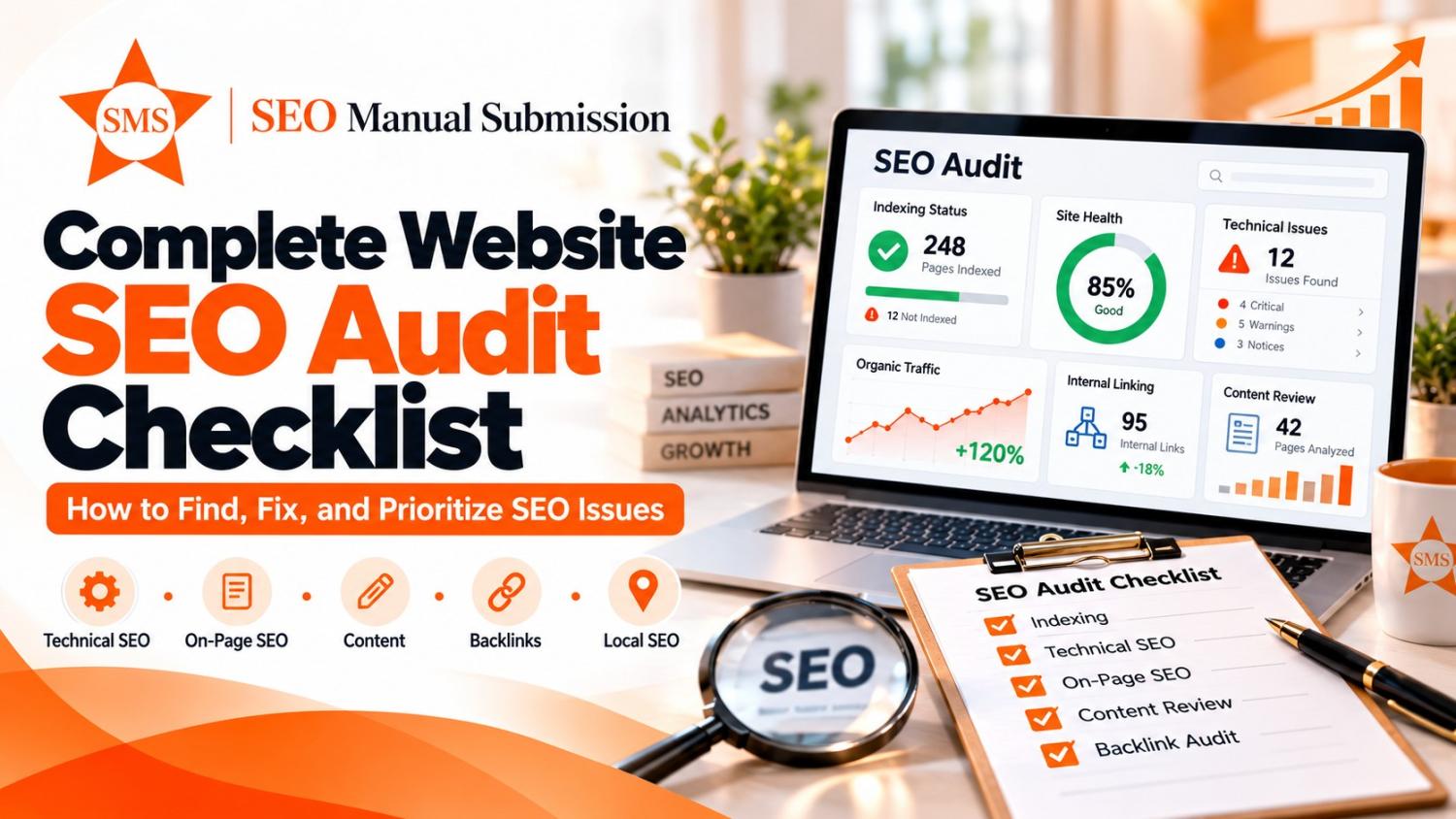
Complete Website SEO Audit Checklist: How to Find, Fix, and Prioritize SEO Issues
A website can look professional, load correctly, and contain hundreds of published pages while still losing valuable opportunities in Google Search. Sometimes the problem is obvious, such as an important page that has accidentally been excluded from indexing. More often, the difficulties are spread across technical configuration, content relevance, internal linking, website structure, and off-page signals.
This is where a comprehensive website SEO audit becomes valuable.
An SEO audit is not simply a report showing broken links, missing meta descriptions, or website performance scores. It is a structured examination of how effectively a website can be discovered, understood, and used by search engines and potential customers.
A properly conducted audit should answer three important questions: What is currently limiting the website's organic search performance? Which problems have the greatest potential impact? And what should be improved first?
Without these answers, businesses risk spending time and money on activities that do not address their actual SEO weaknesses.
This complete website SEO audit checklist explains how to evaluate the most important aspects of a website, identify potential search visibility problems, and develop an improvement plan based on evidence rather than assumptions.
Whether you manage a business website, an online store, a service-based company, or a content-driven platform, the following process can help you make better SEO decisions.
What Is a Website SEO Audit, and Why Is It Important?
A website SEO audit is a systematic evaluation of the factors that influence a website's ability to perform in organic search results.
It examines whether search engines can access and interpret important pages, whether content meets users' expectations, how effectively pages connect with one another, and whether the website provides a useful experience.
An audit also considers external factors such as backlink quality, competitor visibility, and local business information when relevant.
The purpose is not to collect the largest possible number of SEO warnings. It is to understand which issues are significant enough to justify corrective action.
For example, an auditing tool may report missing meta descriptions on several low-priority archive pages. At the same time, an important service page may have an incorrect canonical tag pointing to another URL.
Both findings deserve evaluation, but they are not equally important.
The canonical issue may affect the website's ability to establish the intended page as the preferred search result. The missing descriptions, meanwhile, may represent a lower-priority opportunity for improving how individual pages are presented in search.
This distinction separates useful SEO auditing from simply generating automated reports.
A professional website SEO audit service should help a business understand the implications of its findings and determine which improvements deserve attention first.
Step 1: Establish Your Website's Current SEO Performance
Before examining technical issues or making changes, establish a performance baseline.
This initial assessment helps distinguish existing problems from new developments and creates a reference point for evaluating future improvements.
Review Google Search Console
Google Search Console provides information about how a website performs in Google's organic search results.
Start with the Performance report. Examine the queries that generate impressions and clicks, identify the pages attracting organic visitors, and look for changes in visibility.
Don't evaluate the entire website through a single average position.
A website might have stable overall performance while several important service pages are losing visibility. Similarly, an increase in impressions may come from informational searches that have little commercial relevance.
Review performance at the individual page and query level.
Examine organic traffic and conversions
Google Analytics 4 or another suitable analytics platform can help evaluate what visitors do after arriving on your website.
Look beyond total sessions.
Are visitors reaching your important service pages? Are they completing enquiry forms, purchasing products, requesting quotations, or taking other meaningful actions?
A website attracting thousands of visitors but very few relevant enquiries may have a different problem from one receiving limited organic traffic but converting visitors successfully.
Identify your commercially important pages
Create a shortlist of pages that matter most to the business.
These generally include core service pages, important product categories, high-performing informational resources, and pages supporting valuable customer enquiries.
These URLs should receive particular attention throughout the audit.
Practical audit outcome: You should finish this stage with a clear understanding of which pages are performing, which are underperforming, and what success looks like for the business.
Step 2: Check Google Indexing and Website Crawlability
Even excellent content cannot generate ordinary organic search visibility if the intended page is not eligible to appear in Google's index.
Indexing and crawlability should therefore be among the first technical areas investigated.
Are your important pages indexed?
Open Google Search Console and review its page indexing information.
Pay attention to important URLs that have not been indexed, especially pages intended to attract search visitors.
Use URL Inspection to examine individual pages and understand their reported indexing status.
Some URLs may be excluded intentionally, including duplicate versions, internal search results, or administrative pages. Others may require corrective action.
The aim is not to index every URL on the website. It is to ensure that valuable, indexable content is accessible and eligible for discovery.
Review robots.txt restrictions
The robots.txt file provides crawling instructions for compatible search engine crawlers.
Incorrect restrictions may interfere with Google's ability to access sections of your website.
However, robots.txt is not a reliable way to prevent a URL from appearing in search results. A blocked URL can sometimes still be discovered through external or internal links.
Where exclusion from indexing is necessary, appropriate indexing controls should be used with a clear understanding of how crawlers access the page.
Examine noindex and canonical signals
A noindex directive can prevent a page from being indexed when a crawler is permitted to access and process the directive.
An incorrect directive on an important commercial page may therefore cause serious visibility problems.
Canonical tags require equal attention.
If several URLs contain similar or duplicate content, canonical signals help indicate the preferred version.
Conflicting signals between canonical tags, redirects, sitemaps, and internal links may make it harder for search engines to determine which URL should represent the content.
These problems are especially common on websites with filtered URLs, multiple product variations, tracking parameters, or previous redesigns.
Check XML sitemap quality
An XML sitemap should primarily contain preferred URLs that are accessible and intended for indexing.
Review whether it includes outdated pages, unnecessary redirects, or URLs with indexing restrictions.
A sitemap helps search engines discover URLs, but submission alone does not guarantee crawling, indexing, or improved rankings.
Important: If Search Console reports an excluded page, investigate the reason before treating the exclusion as an error. Many exclusions are expected and require no corrective action.
Step 3: Examine Website Architecture and Internal Linking
Website structure determines how logically information is organized and how easily visitors and search engines can navigate between pages.
A website with hundreds of useful articles can still have discoverability problems when those articles are buried within complicated navigation systems or disconnected from related resources.
Evaluate the page hierarchy
A well-organized service website should make its primary offerings easy to locate.
For example, a digital marketing company might organize its content around broader service categories such as SEO, content marketing, link building, social media marketing, and local SEO.
Supporting pages can then provide more detailed information about individual services.
The hierarchy should reflect genuine relationships between topics instead of being designed solely around keyword variations.
Identify orphan pages
An orphan page has no crawlable internal links pointing to it from other pages within the website.
Such pages may be difficult to discover through normal website navigation, even when they appear in an XML sitemap.
An SEO crawler can help identify potentially orphaned URLs when crawl data is combined with sitemap, analytics, or Search Console information.
Important pages should have relevant internal links from appropriate areas of the website.
Review internal anchor text
Internal links should describe the destination accurately.
Generic phrases such as "click here" can sometimes be appropriate in context, but descriptive anchors usually provide clearer information.
For example, a paragraph discussing website content quality could link naturally to a relevant content marketing service page.
The link should help readers explore a related subject, not interrupt the article with an unrelated promotional message.
A good internal linking strategy considers context, page importance, navigation, and topical relevance.
It does not require every article to contain the same number of links.
Step 4: Perform a Complete On-Page SEO Audit
On-page SEO examines the elements within individual webpages that communicate their subject, purpose, and usefulness.
Unlike some technical problems that affect entire sections of a website, on-page weaknesses often vary considerably between individual URLs.
Title tags and search relevance
A title tag should accurately describe the page and distinguish it from other resources.
Consider a page targeting professional website auditing.
A vague title such as "Our Advanced Business Solutions" provides little information about what the visitor will find.
A descriptive title such as "Professional Website SEO Audit Services" communicates the purpose more clearly.
However, titles should not be overloaded with repeated keywords, exaggerated promises, or unnecessary promotional phrases.
Google may generate its own title link in search results, so a well-written title is an important input rather than a guarantee of how the result will appear.
Meta descriptions
Meta descriptions summarize a page's content and may be used as part of its search result snippet.
Although they are not a direct Google ranking factor, accurate and compelling descriptions can help visitors understand the page before clicking.
Write descriptions that reflect the content rather than inserting keywords mechanically.
Google may also choose text from the page when it considers another passage more relevant to the query.
Heading structure
A clear H1 heading should introduce the primary subject of the page.
Supporting H2 and H3 headings should organize the information logically.
For longer articles, meaningful headings make complex information easier to follow.
Avoid creating headings merely to repeat keyword phrases.
Content relevance and keyword targeting
A useful on-page SEO audit evaluates whether the content serves the intended search query.
If a page targets "local SEO services," it should explain the relevant offering, the businesses that may benefit, and what the service includes.
If the page targets "how local SEO works," readers may expect a more educational explanation.
The subject may be similar, but the user expectations are different.
A detailed on-page SEO optimization service can help address issues involving page relevance, metadata, content organization, and internal optimization across important URLs.
Step 5: Evaluate Content Quality, Search Intent, and Topical Coverage
Content auditing requires more judgment than simply checking word counts or calculating keyword density.
A page containing 3,000 words is not necessarily more useful than a focused 1,000-word resource.
The correct length depends on what the subject requires and what readers need to understand.
Identify outdated or incomplete content
Review older articles for information that is no longer accurate.
This is particularly important for subjects involving search engine documentation, software interfaces, website technology, and online marketing practices.
An older article may still attract visitors but provide instructions based on a discontinued feature.
Updating the relevant information can improve its usefulness.
Don't change publication dates merely to create an appearance of freshness. Substantial revisions should reflect genuine improvements.
Investigate overlapping pages
Websites often accumulate articles that address nearly identical topics.
For example, a business might publish multiple articles explaining how to increase website traffic, improve organic rankings, and optimize pages for search engines.
These subjects can support separate articles, but each needs a clear purpose.
Where substantial duplication exists, determine whether the pages should be differentiated, improved, or consolidated.
Avoid merging pages solely because they rank for some of the same keywords.
Look for missing subject coverage
A website offering SEO services may have extensive articles about backlinks but almost no educational content about technical auditing, search intent, or internal linking.
A content gap analysis can reveal important areas that the website has not adequately addressed.
These gaps should be evaluated based on audience needs and business relevance, not simply on competitor publishing volume.
A well-planned content marketing strategy can help connect informational resources with the services and solutions customers may eventually need.
Review content credibility
Evaluate whether the material provides accurate explanations and appropriately supports factual claims.
Where relevant, include authentic examples, qualified author information, original observations, or credible external references.
Avoid unsupported claims and fabricated case studies.
Trustworthiness is particularly important when content influences purchasing decisions or deals with sensitive topics.
Step 6: Audit Website Speed, Mobile Experience, and Core Web Vitals
Website performance deserves attention because slow, unstable, or difficult-to-use pages can frustrate visitors.
A technically accessible website may still provide a poor experience on mobile devices.
Understand Core Web Vitals
Core Web Vitals are measurements designed to evaluate important aspects of real-world user experience.
| Metric | What it measures | Common good-performance threshold |
|---|---|---|
| Largest Contentful Paint (LCP) | Loading performance | 2.5 seconds or less |
| Interaction to Next Paint (INP) | Responsiveness | 200 milliseconds or less |
| Cumulative Layout Shift (CLS) | Visual stability | 0.1 or less |
These thresholds are evaluated using appropriate field data, commonly at the 75th percentile of page loads.
They provide useful performance targets, but meeting them does not guarantee higher search rankings.
Examine pages under realistic conditions
Use PageSpeed Insights, Lighthouse, and available real-user performance data to identify potential issues.
Pay attention to unnecessarily large images, excessive JavaScript, inefficient resource loading, and layout elements that shift unexpectedly.
Also test the actual experience.
Can mobile users read the content comfortably? Do menus work correctly? Can visitors submit enquiry forms without difficulty?
A website can achieve respectable performance metrics while still having practical usability problems.
The objective is to improve the experience of real users, not simply generate a higher score in a testing tool.
Step 7: Check Structured Data and Search Appearance
Structured data helps search engines interpret certain types of webpage information in a standardized format.
For eligible content, valid structured data may support enhanced search appearances.
Common structured data types include organization information, breadcrumbs, products, articles, and other supported content categories.
However, adding schema markup does not automatically create rich results or improve ranking positions.
What should be reviewed?
Check whether the structured data accurately reflects the visible page content.
Use Google's Rich Results Test where relevant to evaluate eligibility and identify implementation issues.
For a business website, Organization markup may help communicate appropriate business details, while BreadcrumbList markup can describe the site's navigation hierarchy.
Product and other specialized markup should only be implemented when the page genuinely meets the corresponding requirements.
Avoid adding misleading markup or types that do not match the content.
An SEO audit should also examine how important pages appear in search results, including their title links, snippets, and other relevant search features.
Step 8: Review Your Backlink Profile and Off-Page SEO Activities
An SEO audit should extend beyond the website itself.
Backlinks and other legitimate off-page signals can help search engines discover content and understand how websites connect across the web.
However, evaluating backlinks requires more than counting links or comparing third-party authority scores.
Examine link relevance and placement quality
Review which websites are linking to your pages and the context in which those links appear.
Are the linking pages relevant to your subject or industry?
Do they provide useful content?
Would the link make sense to a genuine reader?
A small number of appropriate editorial mentions may be more meaningful than large quantities of unrelated directory links.
Third-party metrics such as Domain Authority or Domain Rating can be useful for comparative research, but they are not Google's own ranking scores.
Identify questionable link-building patterns
Look for evidence of manipulative link schemes, excessive link exchanges, irrelevant placements, or unusual concentrations of keyword-rich anchor text.
Do not assume that every unfamiliar or low-quality backlink requires removal.
Google has systems intended to handle many forms of link spam, and indiscriminate link removal or disavowal may be unnecessary.
Potentially serious unnatural linking issues require careful evaluation.
Assess legitimate link development opportunities
A broader off-page SEO optimization strategy may include relevant editorial mentions, quality directory opportunities, legitimate contributor relationships, and useful content promotion.
For businesses interested in manual link building services, quality control should be central to the process.
Manual review can help assess suitability before pursuing placements, but it does not automatically make a backlink appropriate.
Similarly, selective guest posting and blogger outreach should focus on relevant audiences and editorial value rather than attempting to manufacture ranking signals.
The purpose of a backlink audit is to understand the website's external link profile and identify appropriate next steps.
Step 9: Conduct a Local SEO Audit if Your Business Serves Specific Locations
Businesses operating in particular cities or service areas should include local visibility in their SEO assessments.
Local search involves additional considerations beyond traditional organic website rankings.
Review Google Business Profile information
For an eligible business, examine whether its Google Business Profile accurately represents the company.
Business categories, contact information, operating hours, website links, and other relevant details should be correct.
Reviews should be genuine, and business information should reflect real operations.
Check local business citations
Citations are references to business information appearing on directory websites, industry platforms, and other relevant online resources.
An audit should identify outdated listings, inconsistent contact details, and duplicate profiles where they may cause confusion.
Not every directory deserves a submission.
A focused citation building strategy should prioritize credible, relevant platforms and accurate business information.
Evaluate location-specific content
If a company serves customers in several locations, its website should provide useful and accurate information about the services available in those areas.
Avoid creating large numbers of nearly identical location pages that offer no distinct value.
A professional local SEO service can help assess the relationship between website optimization, location relevance, business profiles, and local search opportunities.
For businesses that depend heavily on nearby customers, this can be an important part of the overall audit.
Step 10: Review Organic Conversions and Lead Generation
A complete SEO audit should not end when technical issues and keyword rankings have been reviewed.
Organic visibility supports a larger business objective.
For a service provider, that objective may be receiving qualified enquiries. For an e-commerce store, it may be generating sales. For a publisher, it might involve attracting relevant readers who engage with its content.
Whatever the objective, the website should make it reasonably easy for visitors to take the intended action.
Examine important conversion paths
Review service pages, enquiry forms, contact information, and relevant calls to action.
Do visitors understand what the business offers?
Is there enough information to evaluate the service?
Are forms working properly on mobile devices?
Can visitors easily locate the next step?
Sometimes, SEO improvements generate additional visitors without producing the expected business results because the website does not adequately support conversions.
This is not necessarily a search ranking problem.
It may be a website usability, messaging, or lead-generation problem.
A comprehensive assessment should recognize these distinctions and avoid attributing every business performance issue to SEO.
Step 11: Prioritize SEO Audit Findings by Business Impact
An SEO audit becomes genuinely useful when its findings lead to sensible action.
One of the most common mistakes is treating every reported issue as equally urgent.
A missing image alt attribute on an otherwise accessible decorative element is not necessarily comparable to an accidental indexing restriction affecting a major revenue-generating page.
Similarly, a broken internal link on a heavily visited service page may deserve greater attention than a minor formatting inconsistency in an old archive.
A practical SEO issue prioritization framework
| Priority | Example of a finding | Recommended approach |
|---|---|---|
| Critical | Important service pages unintentionally marked noindex |
Investigate and correct promptly |
| High | Broken navigation or incorrect redirects affecting important pages | Schedule early remediation |
| Medium | Weak internal linking between relevant content resources | Improve in planned optimization work |
| Medium | Valuable article with outdated or incomplete information | Update based on traffic and relevance |
| Lower | Minor metadata inconsistency on a low-value page | Review during routine maintenance |
Priority should ultimately reflect the affected page's importance, the severity of the issue, and the evidence supporting its impact.
A small website may be able to address most important findings relatively quickly.
A large website may require several development phases and coordination between SEO specialists, writers, designers, and developers.
A useful SEO report should explain not only what is wrong, but why it matters and what action is recommended.
Step 12: Turn Your SEO Audit Into a Practical Improvement Plan
Completing the audit is only the beginning.
Website owners need a manageable process for implementing recommendations and measuring their effect.
The following 90-day framework is an example of how improvement work can be organized. It is not a guarantee that rankings or traffic will improve within that period.
First 30 days: Address essential technical and indexing concerns
Start with issues that directly affect the accessibility, indexing eligibility, or operation of important pages.
Correct significant redirect errors, unintended indexing restrictions, broken primary URLs, and serious website navigation problems.
Ensure that the analytics and performance tracking necessary for future evaluation are functioning correctly.
Days 31–60: Improve important pages and content relationships
Focus on commercially significant pages and valuable informational resources.
Improve page titles, headings, content clarity, internal links, and alignment with search intent.
Update outdated resources and address substantial content duplication where appropriate.
Review website performance and user experience improvements that can be implemented within available resources.
Days 61–90: Strengthen broader SEO opportunities
Evaluate relevant off-page opportunities, business citations, and remaining content gaps.
Consider whether new articles, service-page improvements, or additional technical work will best support business objectives.
Compare performance with the initial baseline, while recognizing that search changes may require more time to be reflected fully.
Document completed work and identify the next set of priorities.
The objective is not to finish SEO in three months.
It is to establish a repeatable approach in which auditing, optimization, measurement, and improvement support one another.
Example: How an SEO Audit Can Change the Direction of a Campaign
Consider a hypothetical service-based business that has been publishing articles and building backlinks for several months.
Its organic traffic has remained relatively flat, so the company plans to increase its content production budget.
Before proceeding, it performs a website SEO audit.
The investigation identifies several problems.
An important service page is not indexed because of an unintended technical setting. Multiple articles target nearly identical subjects without adding distinct information. Some older resources contain useful content but have almost no internal links from relevant pages.
The business also discovers that its contact form is difficult to complete on mobile devices.
In this situation, publishing additional articles may not be the most urgent investment.
A more sensible plan would begin by correcting the indexing problem, improving the content structure, connecting related pages, and addressing the mobile conversion issue.
Only then would the company evaluate which new topics genuinely deserve publication.
This example illustrates why SEO auditing can change the order of marketing priorities.
It does not establish that any particular fix will produce a guaranteed ranking improvement. It shows how diagnosis can help allocate resources more intelligently.
Essential Tools for Conducting a Website SEO Audit
A professional SEO audit often combines several tools because no single platform provides every relevant insight.
| Tool | Main auditing purpose |
|---|---|
| Google Search Console | Search performance, indexing, URL inspection |
| Google Analytics 4 | Visitor behavior, traffic sources, conversions |
| Google PageSpeed Insights | Website performance and Core Web Vitals data |
| Google Lighthouse | Page performance, accessibility and technical checks |
| Screaming Frog SEO Spider | Crawling, metadata, status codes, canonicals and links |
| Google Rich Results Test | Structured data eligibility testing |
| Ahrefs or Semrush | Competitive research, backlinks and keyword analysis |
| Google Business Profile | Local business information and visibility management |
These tools should be treated as sources of evidence rather than automatic decision-makers.
For instance, an SEO crawler can identify duplicate titles, but human evaluation is needed to decide whether the pages are genuinely redundant.
A keyword research platform can estimate search demand, but it cannot determine whether a particular topic will produce qualified customers for your business.
Similarly, a performance tool can identify a technical opportunity without establishing whether that issue should take priority over all other findings.
Good SEO auditing combines data collection, interpretation, and business judgment.
How Often Should You Perform a Website SEO Audit?
The appropriate auditing frequency depends on website size, publishing activity, technical complexity, and business requirements.
A small company website that rarely changes may not require the same review schedule as a large e-commerce platform that continuously introduces new products, categories, and URLs.
Regular monitoring of indexing, organic visibility, and technical warnings is useful for most business websites.
A more comprehensive audit may be appropriate after a major redesign, website migration, substantial content restructuring, unexplained traffic decline, or significant change in SEO strategy.
The important distinction is between monitoring and full auditing.
Monitoring helps detect changes and potential issues.
A complete audit examines the wider relationship between technical performance, content, website structure, off-page activity, and business objectives.
For organizations investing continuously in organic growth, periodic comprehensive reviews help prevent small problems from accumulating unnoticed.
When Should You Consider a Professional Website SEO Audit?
Many basic auditing tasks can be completed by website owners using available tools.
However, some situations require specialist knowledge.
Large websites with complex navigation, persistent indexing problems, JavaScript-heavy architecture, difficult migrations, extensive international targeting, or unexplained organic traffic losses may need deeper investigation.
Professional assistance can also be useful when a business has accumulated multiple SEO reports but does not know which recommendations deserve priority.
The value of a professional assessment should come from its interpretation and recommended actions—not simply from delivering a large document filled with automated warnings.
At SEO Manual Submission (SMS), our digital marketing offerings include website SEO auditing, on-page optimization, off-page SEO, content marketing, manual link building, local SEO, and related services.
Our Complete SEO Services page provides an overview of available optimization solutions for different business requirements.
For websites requiring a broader review of technical and optimization concerns, you can also explore our Website SEO Auditing Services.
The appropriate starting point depends on the website's present condition and the specific problems that need investigation.
Frequently Asked Questions About Website SEO Audits
1. What is included in a complete website SEO audit?
A complete website SEO audit commonly examines crawling, indexing, technical configuration, on-page optimization, content quality, website architecture, internal links, mobile usability, performance, structured data, and backlinks. It may also cover local SEO, conversion paths, and competitive positioning where relevant. The depth of the audit should reflect the website's size and business objectives.
2. How long does a website SEO audit take?
The required time depends on the website's complexity and the depth of investigation. A small website with relatively few pages may be evaluated more quickly than an e-commerce platform containing thousands of URLs, complicated filtering systems, and historical technical problems. Automated crawling can collect information quickly, but interpreting findings and developing meaningful recommendations requires additional analysis.
3. Can I perform an SEO audit without paid tools?
Yes. Website owners can begin with Google Search Console, Google Analytics, PageSpeed Insights, Lighthouse, and other freely available resources. These tools provide useful information about search performance, indexing, and website experience. Larger or more complex websites may benefit from specialized crawling and competitive research platforms.
4. Does fixing every SEO audit error guarantee better rankings?
No. Search rankings depend on many factors, including content relevance, competition, website quality, and Google's ranking systems. Some audit findings are minor, while others may have significant consequences. Resolving technical or content problems can improve a website's foundation, but no audit can guarantee specific search positions.
5. What is the difference between technical SEO auditing and on-page SEO auditing?
Technical SEO auditing primarily examines how the website functions for crawlers and users, including accessibility, indexing, canonicalization, redirects, performance, and website structure. On-page SEO auditing focuses more directly on individual page elements, content relevance, titles, headings, and other factors that communicate a page's purpose. Both are important parts of a comprehensive website assessment.
6. Should I audit my website before investing in backlink building?
An initial audit is generally advisable because it helps identify problems that may reduce the value of further marketing investment. Building additional backlinks is unlikely to resolve an important page's unintended indexing restriction or compensate for content that fails to address search intent. A review can help establish whether technical, content, or off-page activities should receive priority.
7. Can an SEO audit help recover lost organic traffic?
An audit can help identify possible causes of declining search performance, including technical changes, lost indexing, content problems, and changes affecting important pages. However, not every decline is caused by a website defect. Competition, search demand, and changes in search results can also influence traffic. Recovery recommendations should follow an investigation into the actual cause.
8. Is an SEO audit useful for a new website?
Yes. Auditing a new website can help establish a sound technical and structural foundation before substantial content development or promotion begins. Important areas include correct indexing configuration, logical navigation, appropriate page targeting, mobile usability, analytics setup, and internal linking. Early reviews can help prevent avoidable problems as the website grows.
9. What is the most important part of an SEO audit?
There is no universally most important component because websites face different challenges. For one website, indexing may be the biggest concern. For another, weak content relevance or poor website structure may be limiting performance. The most important part of an effective audit is identifying which findings have the greatest relevance to the website's search visibility and business objectives.
10. How can I get a professional analysis of my website?
You can begin with basic performance and indexing checks using Google's tools. If deeper investigation is needed, a professional website SEO audit can help assess technical issues, content, website structure, and wider optimization opportunities.
SEO Manual Submission provides a Free Website Analysis option for businesses interested in an initial review.
For more specific service requirements, visit our Request a Free Quote page to discuss your website and optimization objectives.
Final Thoughts: An Effective SEO Audit Should Lead to Better Decisions
A comprehensive SEO audit provides more than a list of technical problems.
It gives businesses an opportunity to understand how their websites perform, where unnecessary obstacles exist, and which improvements are likely to deserve attention.
The most productive audits examine the relationship between technical accessibility, content relevance, website architecture, user experience, and external visibility.
They also recognize that not every warning requires immediate action and that higher rankings are not the only measure of SEO success.
The real value comes from identifying meaningful problems and developing a strategy to resolve them in a sensible order.
If your website has been struggling to attract relevant visitors, an audit is a practical starting point. It can help determine whether the next investment should go toward technical repairs, content improvements, internal linking, local optimization, or other areas.
For a deeper explanation of the problems that commonly limit search performance, read our related guide: Why Your Website Is Not Ranking on Google: Common SEO Problems and How to Fix Them.
A successful SEO strategy does not begin with doing everything. It begins with understanding what needs to be done—and why.
SEO Manual Submission helps businesses explore website optimization opportunities through professional SEO and digital marketing services. Visit SEO Manual Submission to learn more about our services and available solutions.
Comments:
Leave A Comment:
Author

Recent Posts




08 Jan 2026

23 Dec 2025


Share Page
Related Keywords
Subscribe to our newsletter
To get latest news / trends in digital marketing subscribe to our newsletter. We don't spam your inbox, we sent only latest news, offers one or hardly two times per month.